|
 |  |
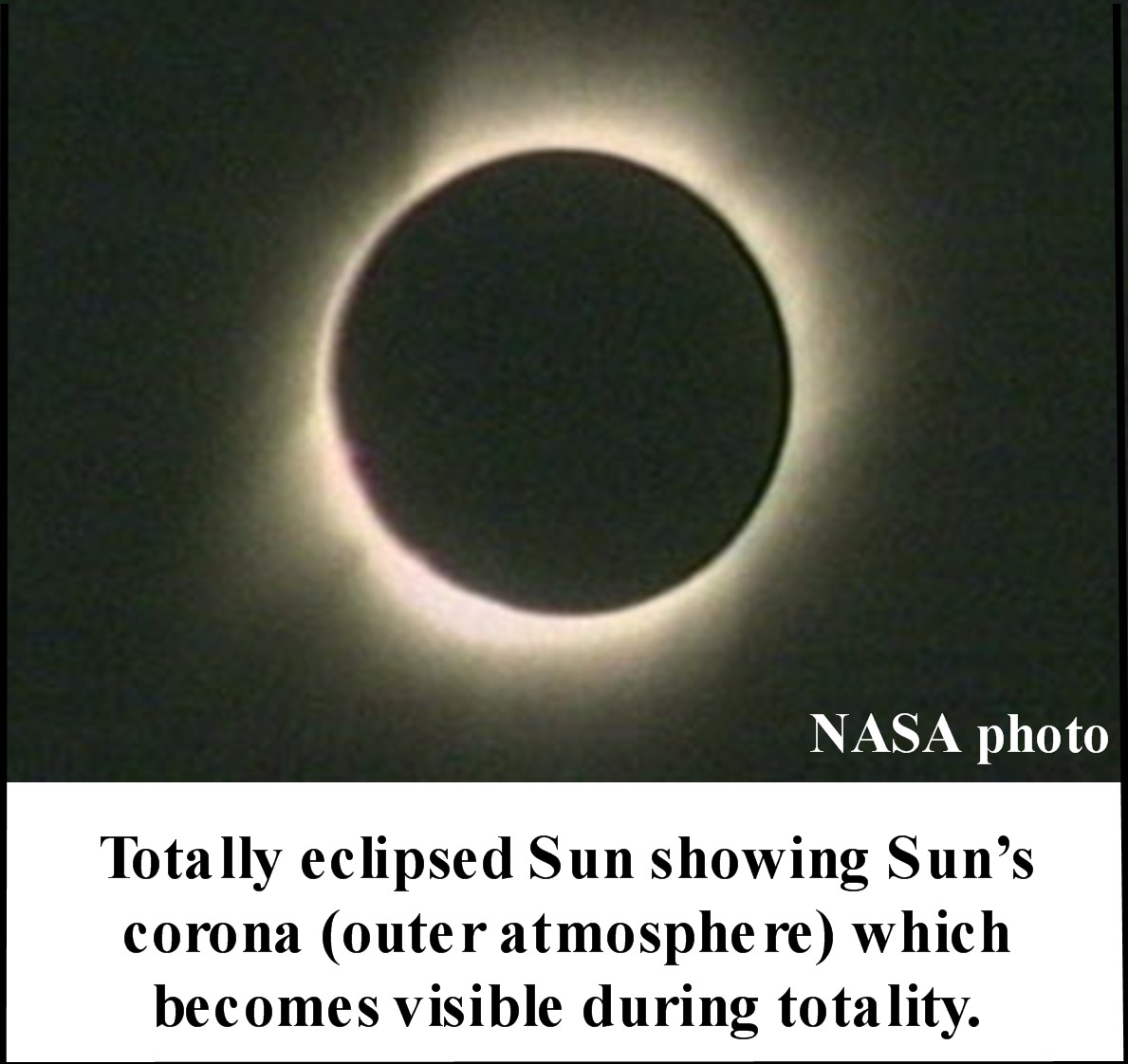
LEFT: When the Moon passes exactly between the Earth and Sun, the result is a total solar eclipse.
RIGHT: When the entire Moon passes through the shadow of the Earth, the result is a total lunar eclipse.
RIGHT: When the entire Moon passes through the shadow of the Earth, the result is a total lunar eclipse.
August 21, 2017 Total Solar Eclipse The August 21, 2017, total solar eclipse was the first one I had seen and it was an absolute thrill. The path of totality entered the U.S. in Oregon, moved southeasterly across the heartland, and exited in South Carolina. Its point of maximum duration of 2 minutes and 40 seconds was in western Kentucky. Along with my family we viewed the eclipe from the Prairie Oasis RV Campground and Park near Henderson, Nebraska, where the duration was only 10 seconds less than its maximum. Almost up to the last minute, the skies were touch-and-go, but just in time the clouds cleared in the direction of the Sun and we got a fantastic view. Shortly after the Sun disappeared, our precious 4-year old grandson said to his mom with a bit of concern in his voice: "Is it coming back?" Someone cited only as A. Sinclair has created a great animated diagram showing the path of the 2017 eclipse as it moved across the planet. The tiny black dot is the path of totality from which a totally eclipsed Sun was seen. People in the gray area saw a partial eclipse; the nearer one is to the path of totality, the greater the percentage of the Sun is eclipsed. [This diagram was posted on Wikimedia -- a great site for free-use and public domain materials.]

|
 |  |
LEFT: Family posing while awaiting totality.
RIGHT: Family viewing the parially eclipsed Sun soon before totality
RIGHT: Family viewing the parially eclipsed Sun soon before totality
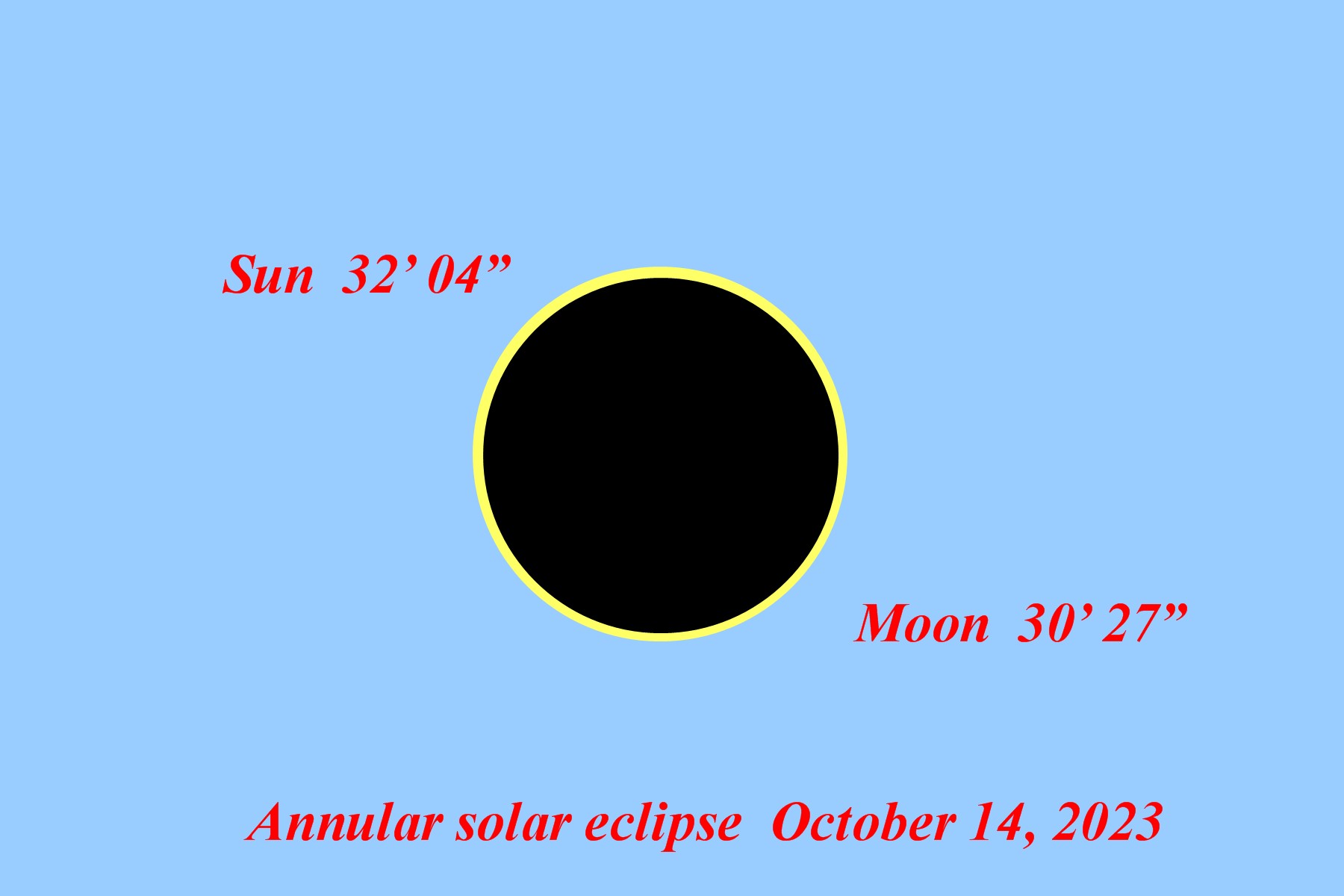
Oct. 23, 2023 Annular Eclipse Oct. 23, 2023, being exactly aligned between Earth and Sun, the Moon eclipsed the Sun at mid-day. Since the Moon was only 5 days after apogee, its farther point from Earth in its elliptical orbit, it wasn't large enough to fully cover the Sun. The graphic shows the apparent size of the Sun (32' 04") with the slightly smaller apparent size of the Moon (30' 27") leaving a ring of unobscured sunlight. (See map and animation) The areas beneath the narrow eclipse path saw a "ring of fire" annular eclipse during which 90% of the Sun was covered by the Moon. Viewers in the path may have noticed a slight dimming of the sky - but nowhere near darkness. The remaining unobscured 10% of the Sun's surface was still quite bright - sufficient to damage eyes. In the Texas hill country from which I observed, the partial eclipse lasted some 3 hours, beginning around 10:20 a.m. CDT and ending around 1:20 p.m. with the annular eclipse lasting about 4 minutes around 11:50-11:54 a.m. Those outside the path saw a partial eclipse, the amount of coverage of the Sun depending upon the nearness to the path. The U.S. map shows how much of the Sun was eclipsed from locations within the entire country. The following are the amounts of coverage in some selected areas: Austin, TX - 89% / Ft. Davis, TX - 87% / Waco, TX - 85% / Houston/Galveston, TX - 85% / Dallas, TX - 81% / Denver, CO - 79% / Tyler, TX - 79% / Des Moines, IA - 54%.
|
 Eclilpse diagram: created by author / Map: Michael Zeiler, GreatAmericanEclipse.com / Animation: Fred Espenak, NASA
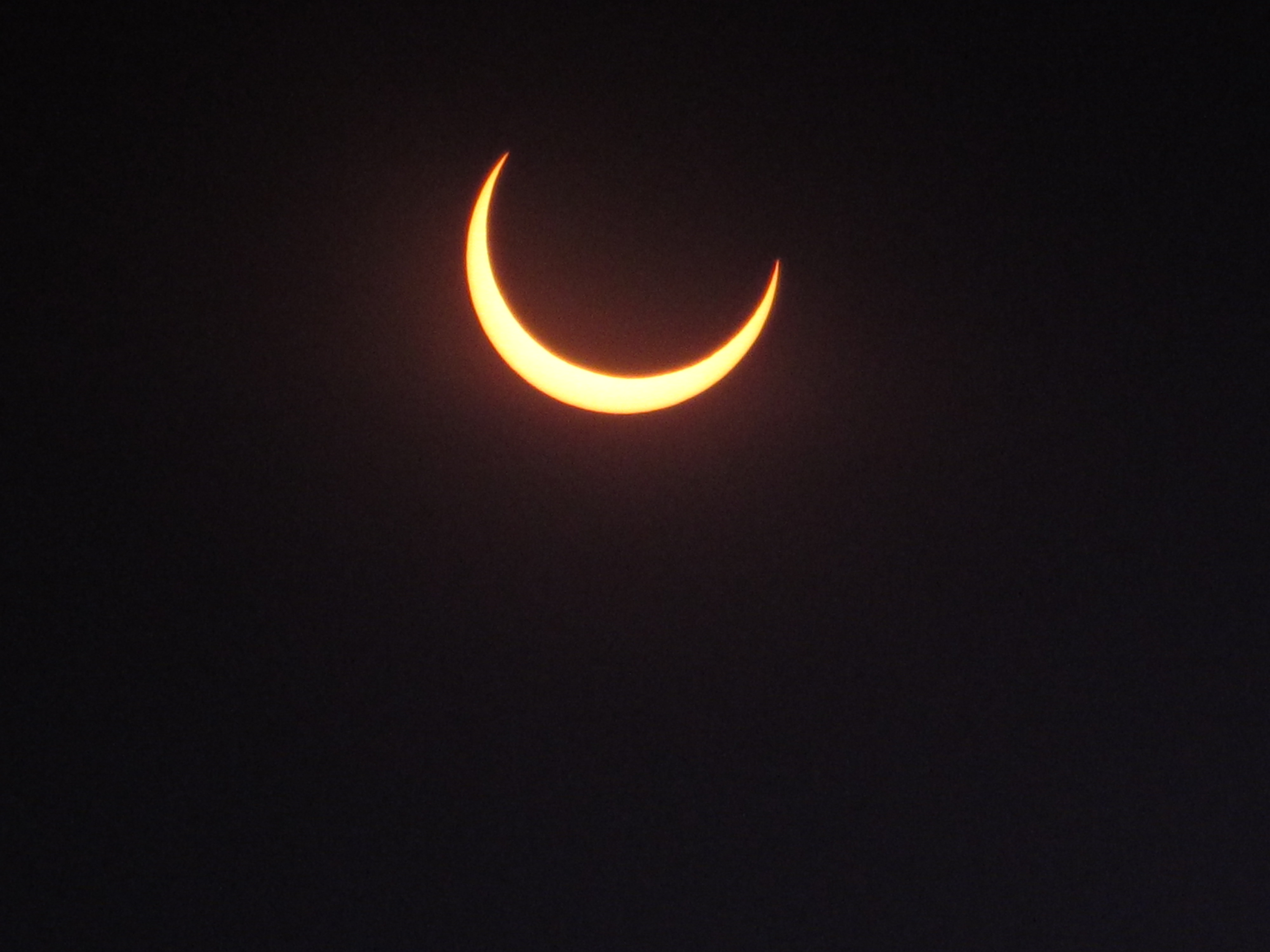
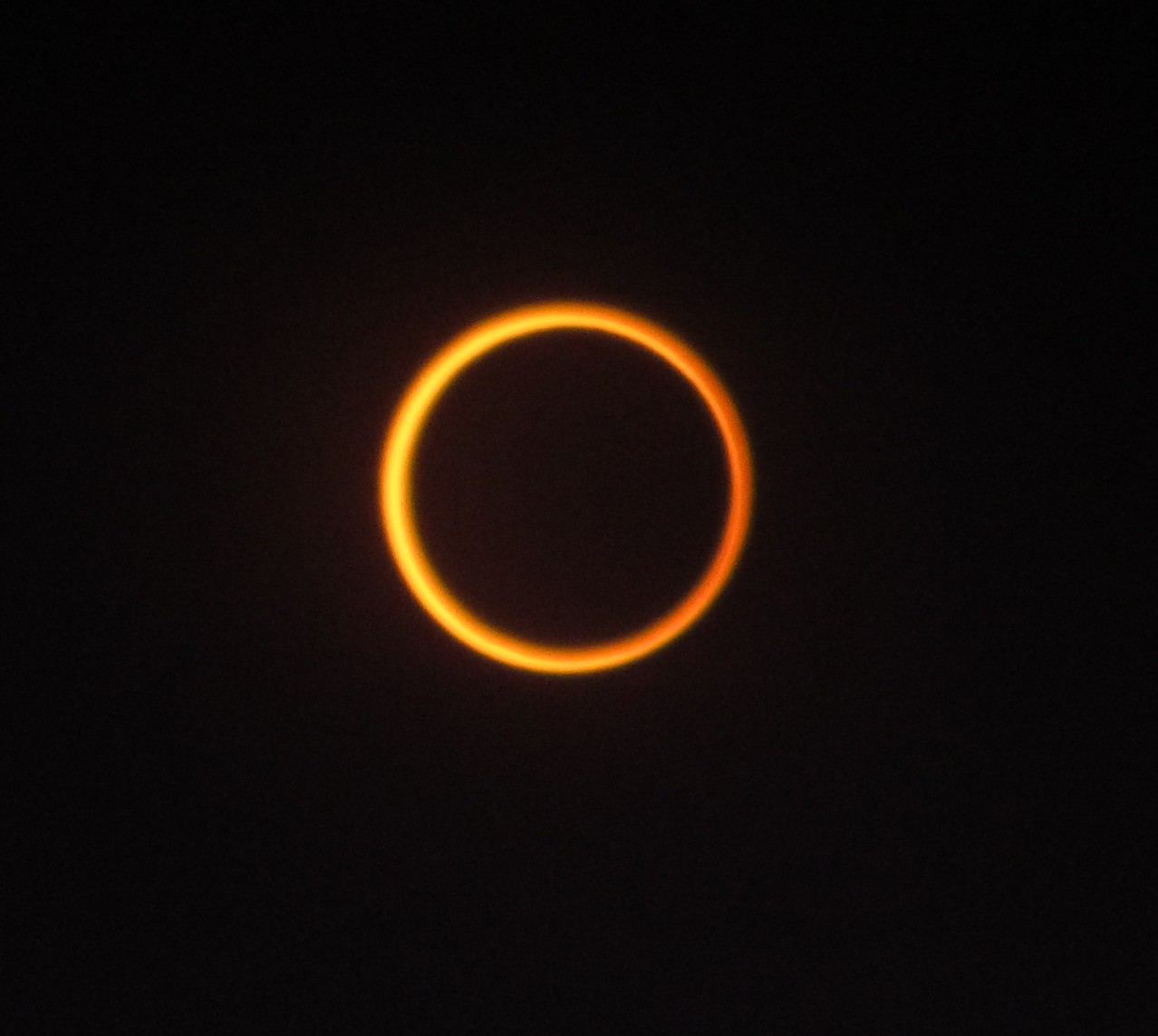
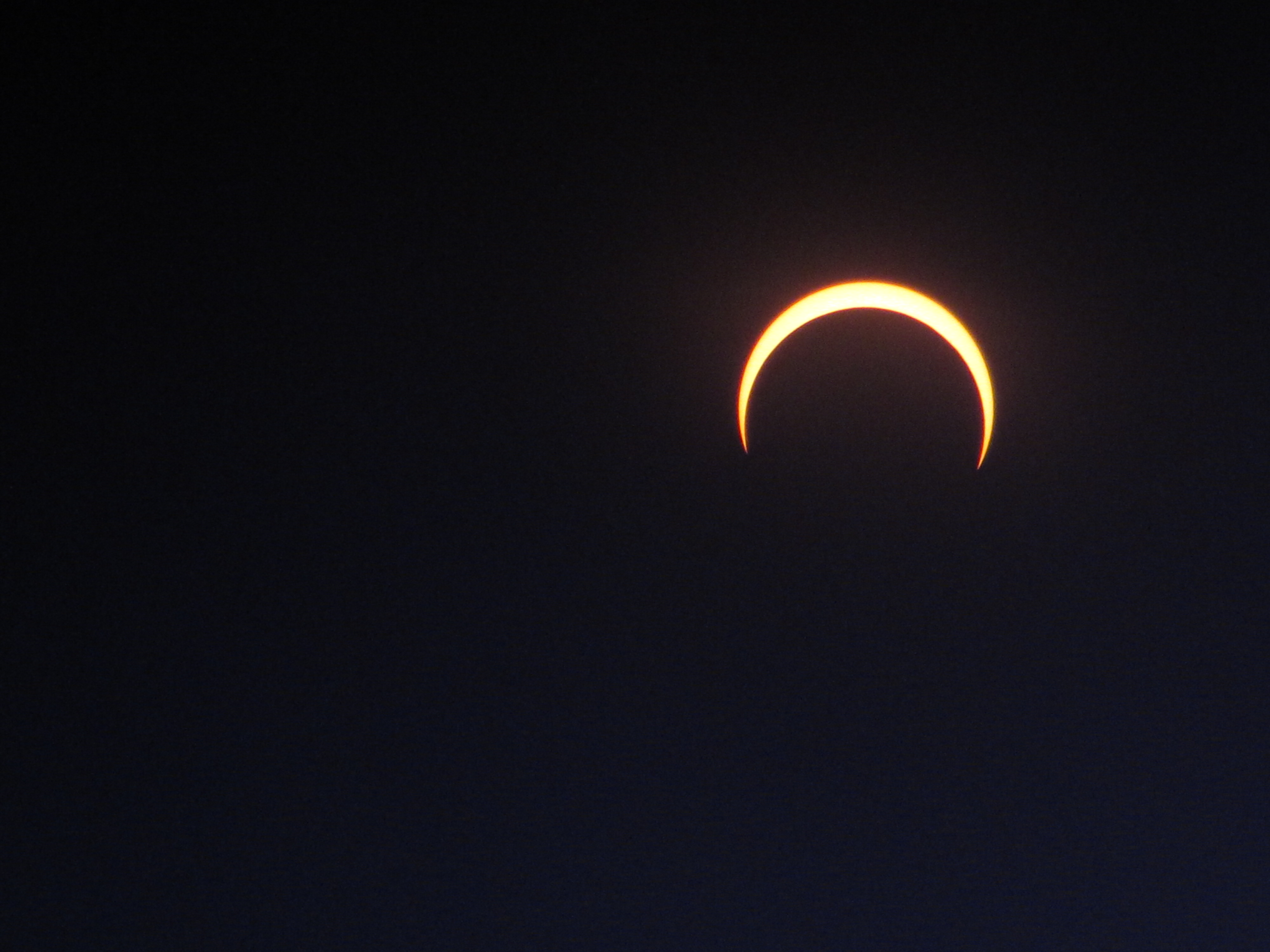 Author's photos of partial eclipse before (left), during annular eclipse (center), partial eclipse after (right)
Apr. 8, 2024 Total Solar Eclipse In an Aug. 7, 1999, Stargazer newspaper column, I wrote: "There will be a total eclipse of the Sun visible from Central Texas on April 8, 2024 - a mere 25 years from now… The eclipse path in the U.S. will stretch from Texas to Maine. Most North Americans will see at least a partial eclipse. Central Texas will be within that narrow path of totality. Around noon, our skies will darken, the brighter stars and planets will become visible, and the Sun's corona will come into view. It should be awesome, an event of a lifetime…" Well, the day finally came. By 2024, we had moved up north from Waco, but made it a point to be back in Waco for the eclipse. Once we were within two-week range of the weather forecasts for April 8, the situation looked rather grim for seeing the eclipse from Central Texas - cloudy morning with afternoon thundershowers predicted. I checked it every day, hoping the prospects would improve, but they didn't. Even two days, and then one day before, it was still looking "iffy" at best. The morning of the eclipse morning showed some hopeful signs but was still concerning. However, as the morning progressed, things began looking more hopeful - certainly not a sure thing, but definitely better. As the partial began around 12:30 p.m., the Sun was in and out of clouds, but out enough that we watched the Moon increasingly cover the Sun. And it gradually got even better. At about 1 p.m., the Sun was about half eclipsed and by 1:30 p.m. totality was merely minutes away with the Sun still clearly visible. As totality arrived, the Sun's corona was easily visible and remained so throughout the 4+ minutes of totality. At one point our daughter Karen pointed out and asked about a bright spot at the 5 o'clock position at the edge of the Moon inside the corona. It was whitish like a star, but clearly not a star, so we surmised it was probably a solar flare. (Photos we saw later taken by others confirmed our guess.) Even though we could see the eclipse - and were extremely grateful for that - there was still considerable cloudiness and haziness all around, and the sky never got as dark as I expected. It was dark enough that we easily saw Venus and Jupiter when they weren't behind clouds. I didn't spot the other three naked-eye planets or any 1st mag stars although admittedly I didn't spend much time looking for them. At the moment of totality, the ambient surroundings became darker, approaching that of a bright moonlit night. I made it a point to video the crowd shortly before and upon totality, hoping to capture the rapid change from daylight to night-like. Unfortunately, my phone's camera immediately began to automatically adjust to the decreased light and brightened the image. Thus, while thrilled that the recording vividly captured the dramatic responses of the people, I was disappointed it failed to fully capture the degree of darkness during totality. (See before and during totality frames from video.) All that being said, any disappointments paled in comparison to the deep gratification of seeing the eclipse I'd been awaiting 25 years. At age 83, it was the last check-off item on my life bucket list. While I was delighted to see the total solar eclipse with our family in a cornfield in Nebraska in 2017, this one was even more special as we shared this one with our family AND some of our dearest friends who had never seen one. It made me even more keenly aware that such a dramatic event is so far more satisfying when shared with important others. It's absolutely better as a social than a solitary happening. We'll never forget what we shared together April 8, 2024.

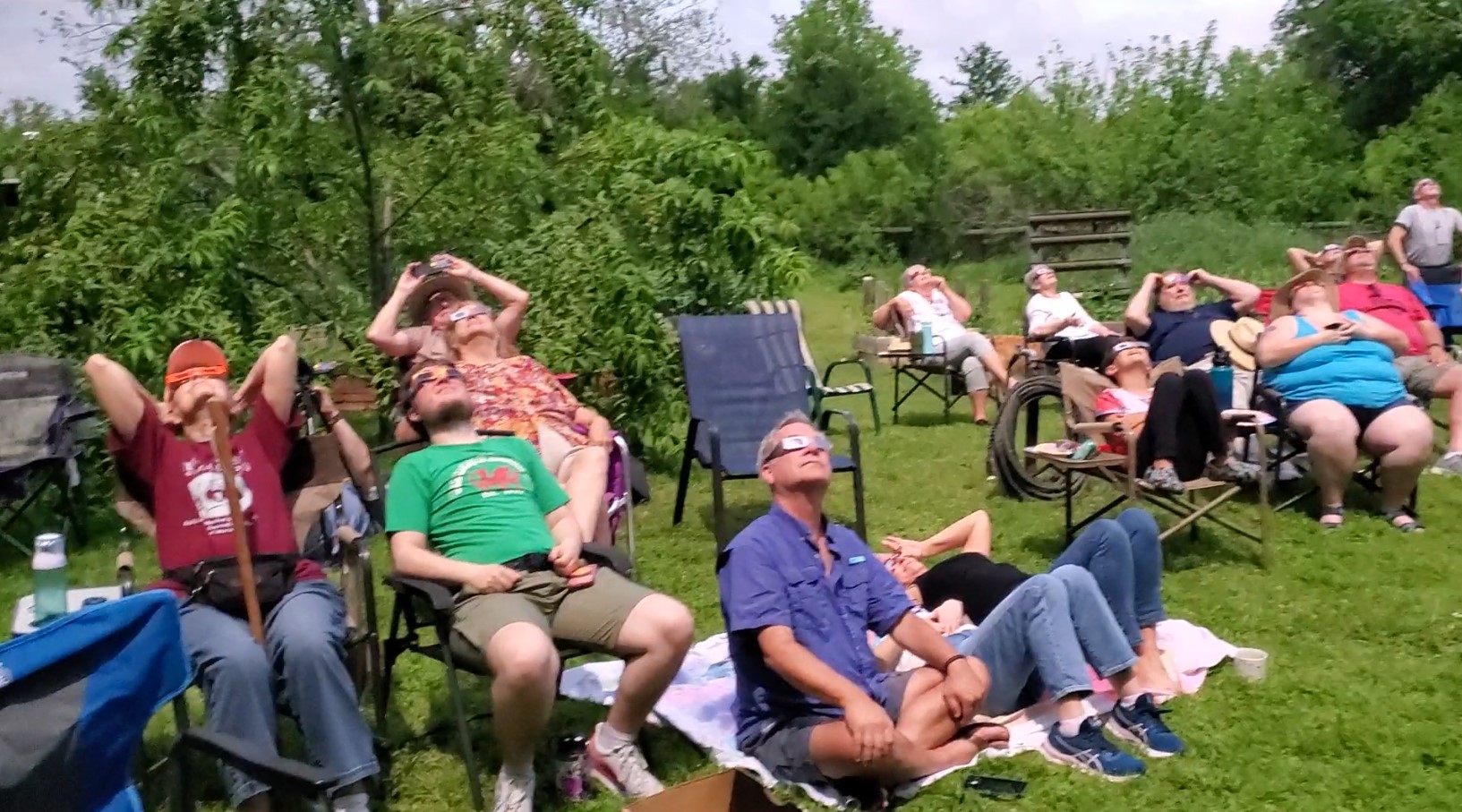
Viewers just before totality
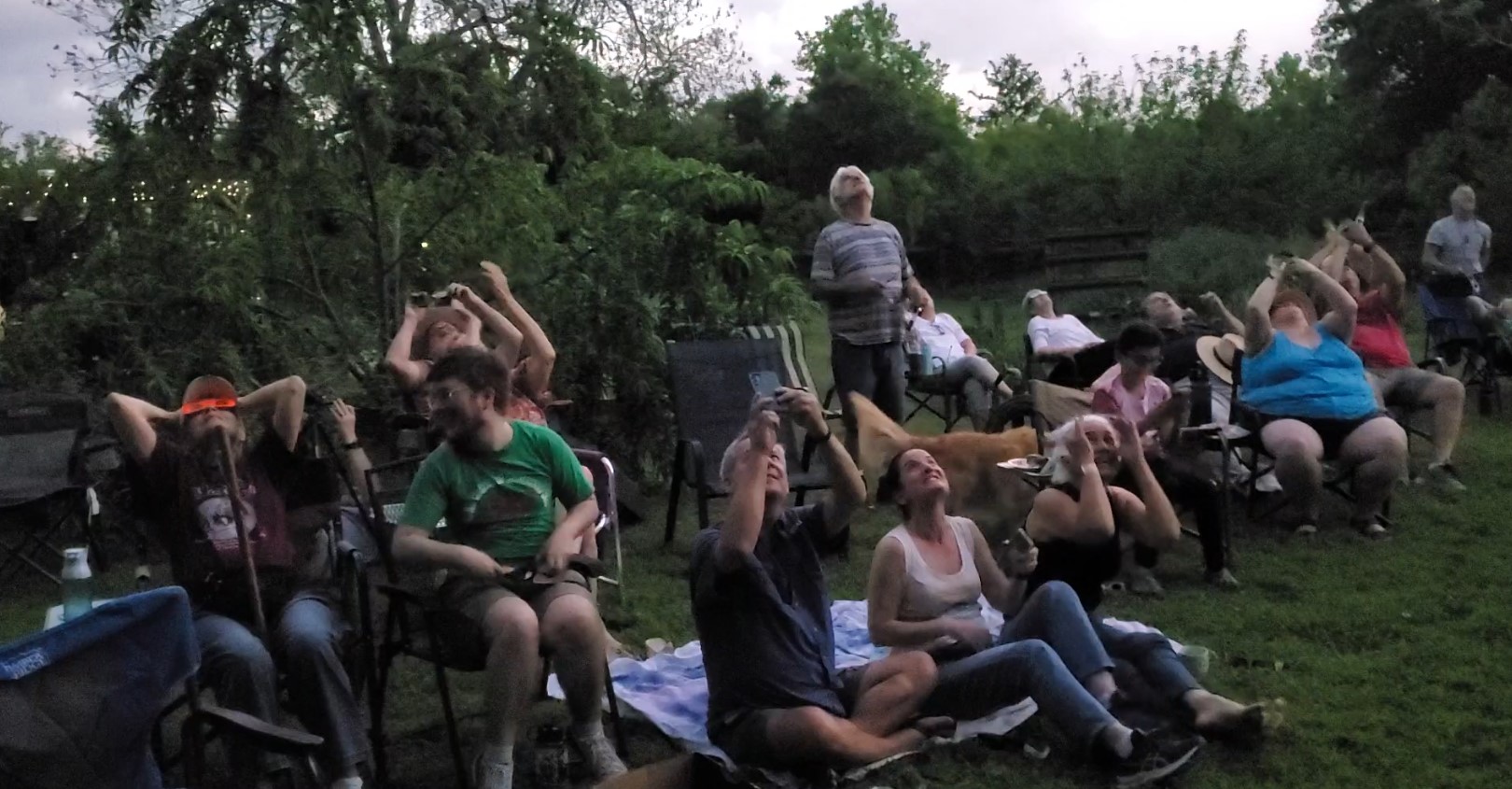 Viewers at the moment of totality

